Key takeaways
- Streets, water, sewer, power, gas and communications must be coordinated.
- Utilities have their own design steps, schedules and standards.
- Inspections happen at each layer before the next is built.
- Acceptance by the city or utility ends the developer's construction responsibility.
Streets and curbs
Residential streets are built from the ground up: a compacted subgrade, stone base, curb and gutter, then asphalt. Widths, grades and turn radii follow local standards, and sidewalks and street trees are often part of the section.
Streets may be dedicated to the city or county, or remain private and maintained by an association.
Water and sewer
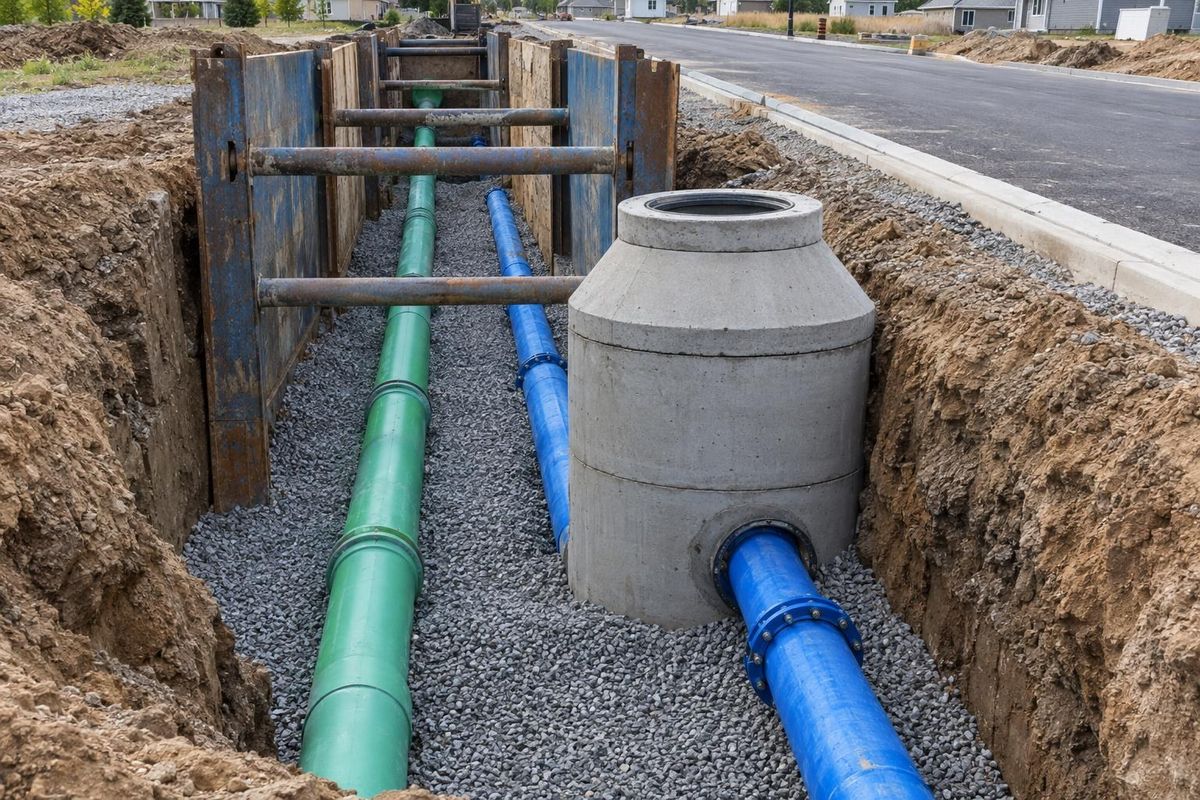
Water mains with valves and hydrants, and sanitary sewer lines with manholes, are laid in trenches under or beside the street, with a service stub to each lot. Pipe is tested before it is covered. Utility providers review plans and inspect the work.
If lines must be extended to reach a site, that work and its timing become a major part of the schedule.
Power, gas and communications
Electric, gas, telephone, cable and fiber each have their own provider and process. Their lines share trenches and easements, and transformers and pedestals must be placed to serve each lot. Early requests are important, because provider queues can be long.
Street lighting adds another coordination point.
Inspection and acceptance
Local inspectors and utility inspectors check work at stages: subgrade, base, pipe and final surface. When everything passes and records are delivered, the city or utility accepts the infrastructure.
After acceptance, maintenance becomes the responsibility of the public agency or the association, depending on ownership.
Official sites to explore
Brand names and logos belong to their owners. These links open the official websites in a new tab, and we are not affiliated with them.
- Metro Water ServicesWater, sewer and stormwater services for Nashville and Davidson County.
- Nashville Electric ServiceElectric utility serving Nashville and much of Davidson County.
- Middle Tennessee ElectricElectric cooperative serving several Middle Tennessee counties.
- Piedmont Natural GasNatural gas utility serving parts of Middle Tennessee.
- Call 811Service that marks buried utility lines before you dig.
Quick answers
Why do utilities take so long?
Each provider has its own design review, material lead times and construction queue. Starting early is the biggest help.
Who owns the pipes?
In most cases the utility, after acceptance. Some private lines belong to the owner or association.
Are lines buried?
In most new communities, yes. Underground service is common and often required.